
| Disclosure: Just to be open and honest the buttons and links you click on in the website will in most cases take you to another website where you can purchase the products I am reviewing. As an Amazon Associate I earn from qualifying purchases. |
Common Wading Mistakes That Ruin a Day on the River
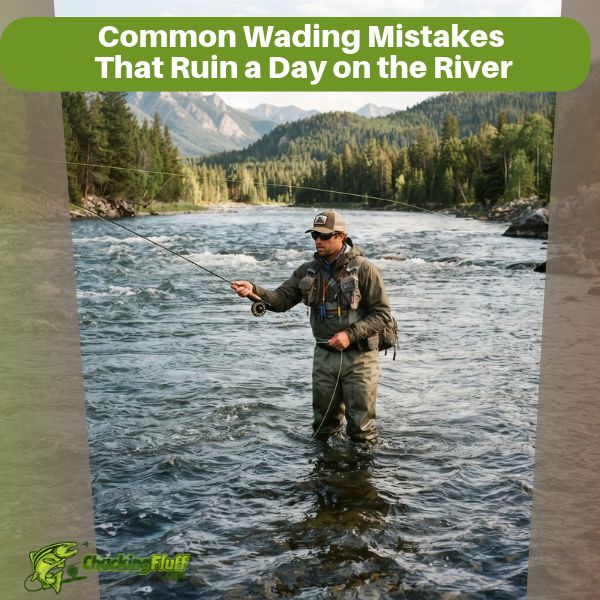
The most common wading mistakes in fly fishing are walking into water you have not fished yet, crossing at a bad spot, lifting your feet instead of shuffling, skipping a wading belt, ignoring cold and rising flow, and wearing gear that fights you. Each has a simple fix, and most you can apply on your next trip.
What are the most common wading mistakes beginners make?
Beginners tend to make the same handful of errors, and almost all of them come from treating the river like a sidewalk. Once you are standing in moving water, every step affects your balance, your safety and the fish around you.
Here is the short list, which the rest of this article covers in order:
- Stepping in before fishing the water at your feet
- Crossing where the river is deep or fast
- Picking your feet up instead of sliding them
- Wading without a belt or a staff
- Wearing gear that is loose, bulky or wrong for the water
- Staying in as the water gets colder or higher
- Panicking after a fall
Why does wading straight into the water spook fish?
Wading straight in spooks fish because trout often hold close to the bank and in the shallow edges, and you walk right through them. They feel the vibrations of your boots and see the movement of your body well before your fly is anywhere near them.
The fix is to fish the near water first. Stand at the edge, cast to the closest lies, and only then take a step or two. Work upstream or across in small moves instead of marching to the middle and casting back at the water you just crossed.
Move slowly, and pause after each step so the silt you kicked up can drift away. Muddy, disturbed water downstream of you is a warning to every fish below. If you are curious how presentation errors add to the problem once your fly lands, dry fly presentation mistakes that spook fish covers that side of it.
One more habit to build: look at the bottom before you step on it. In autumn and spring, trout spawn on clean, pale patches of gravel called redds. Walking through them crushes eggs, so step around any cleared, lighter-colored gravel.
How do you pick a safe place to cross a river?
Pick the widest, shallowest stretch you can find, usually the tail of a pool or a broad riffle where the current spreads out. Wide water is slower and shallower than the narrow, funneled sections, and it gives you room to find footing.
Avoid crossing in these places:
- Just above a drop-off or a deep slot, where a slip carries you straight into trouble
- Through a narrow chute where all the flow is squeezed together
- Anywhere the water looks smooth but dark, which often means deep
- Directly below a big boulder or log pile, where the bottom can be uneven
Before you commit, look at what is on the far side. If you cannot see a safe exit on the other bank, such as a gravel bar or a gentle slope, choose a different crossing.
Cross at a slight angle rather than straight across, and keep your upstream shoulder pointed into the current. Reading the river from the bank pays off here, and how to read water for nymph fishing success explains how to spot depth, speed and seams, which helps you pick crossings as well as fish.
What is the right way to move your feet on a slippery bottom?
Shuffle your feet along the bottom instead of lifting them and stepping. Keeping one foot planted while you slide the other forward means you always have a solid point of contact, and you feel the rocks before you put weight on them.
Some habits that help:
- Keep your feet about shoulder width apart for a stable base.
- Slide the downstream foot first only when you are sure of the footing, then bring the other up beside it.
- Never cross your legs or bring your feet together in current.
- Test each spot with your toe before you shift your weight.
- Keep your knees slightly bent so you can absorb a slip.
Algae-covered rocks are the slipperiest, and they often look harmless. Rocks that are rounded and green or brown with slime are worse than gravel or rough, clean stone. When you have a choice, step on the cleaner surface.
Watch your casting too. Many beginners turn their upper body to watch a drift and lose their footing without noticing. Plant your feet first, then cast.
Should you wear a wading belt and use a staff?
Yes to both. A wading belt cinches your waders at the waist so that if you go under, far less water pours into the legs, and a staff gives you a third point of contact in fast or uneven water.
Tighten the belt snugly over the waders, but not so tight that it is uncomfortable. It is a small strap that makes a falling-in situation much easier to survive.
A wading staff works best when it is planted upstream of you, so the current pushes you against it instead of pulling you off balance. Move one point at a time: staff, then one foot, then the other foot. A staff can be a collapsible pole you clip to your belt, or a sturdy stick if you are only testing the idea. Many beginners skip it because it looks like something for older anglers, then find themselves stuck mid-river with nothing to lean on.
What wading mistakes come from gear that does not fit or suit the water?
Gear mistakes usually come from waders that are too baggy, boots that do not grip the bottom you are standing on, or too many pieces of equipment hanging off your body. Baggy waders catch current and trap water, and loose boots lead to rolled ankles.
Check these points before you step in:
- Wader legs should not bunch or billow around your knees, since that fabric catches current like a sail.
- Boots should be laced firmly with no heel slip, and the soles should suit the riverbed you fish. Slick, algae-covered rock and sharp gravel call for different traction.
- Keep your pack, net and tools on a short, close arrangement so nothing swings or drags in the water.
- Wear layers underneath that do not soak up water or restrict movement.
If you are unsure whether your waders and boots are set up properly, that is a buying and fit question rather than a technique one, and it is already covered in the waders guide linked at the end of this article.
How do cold water and rising flows catch beginners out?
Cold water drains your strength and judgment faster than most beginners expect, and rising flows can turn a wadable crossing into a dangerous one without any obvious warning. Both build slowly, so you often notice them late.
For cold, dress for the water temperature rather than the air. Fleece or synthetic layers under your waders hold warmth when damp, while cotton does the opposite. If your legs go numb or you begin to shake, get out, warm up and rest, because numb legs are poor at feeling the bottom.
For flow, check conditions before you leave home and again when you arrive. Rain upstream, snowmelt and dam releases can all raise a river while the sky above you looks clear. Here are some easy ways to track it:
- Pick a rock at the water’s edge when you arrive and glance back at it now and then. If it disappears, the river is rising.
- Notice the water color. A sudden shift to muddy or cloudy often means more water is arriving.
- Leave your crossing point in mind. If you can no longer cross back safely, you need to leave while you still can.
Remember that you need to get back to the bank you started from. Many beginners cross easily in the morning, then find the same crossing too strong in the afternoon.
What should you do if you fall in?
If you fall in, stay calm, keep your feet pointed downstream, and let the current carry you toward slower water instead of trying to stand up right away. Standing in fast current can trap a foot between rocks.
Follow this sequence:
- Roll onto your back with your feet up and pointed downstream, toes toward the surface.
- Keep your head up and look where you are going.
- Swim gently toward the bank at an angle, using your arms.
- Stand only when the water is slow and shallow enough that you can put both feet down.
- Once you are out, get warm and dry right away. Swap into dry clothes if you have them.
Wearing a belt matters here, since it limits how much water fills your waders. After a fall, treat it as a reason to stop for the day if you are cold or shaken, because fatigue leads to a second fall.
Which wading mistakes can you fix before your next trip?
Almost all of them, and most cost nothing. You can change habits without buying anything.
- Practice shuffling your feet in shallow, slow water until it feels automatic.
- Fish the water at your feet first on every outing.
- Look at flow reports before leaving, and choose crossings from the bank.
- Put a wading belt on every time, and add a staff if your river has a strong current.
- Check your boots and wader fit at home, not at the river.
- Think through your fall plan once, so you do not have to invent it in the water.
FAQs
Is it okay to wade in the middle of a river?
Yes, if the water is shallow and slow enough to keep your balance, but fish the near bank first. Many trout sit in shallow edges, so wading straight to the middle often spooks them before you cast.
Should I wade upstream or downstream?
Upstream is generally easier on both fish and footing. Trout face into the current, so approaching from below keeps you behind them, and the current pushes your legs toward the bottom instead of out from under you.
Do I really need a wading staff as a beginner?
It is not required, but it helps most in fast or uneven water. A staff gives you extra balance when the bottom is slippery, and it is a cheap way to improve stability while you build confidence.
How deep is too deep to wade?
There is no single safe depth, since speed matters as much as depth. If the water pushes hard against your legs or you cannot see the bottom, move to a shallower spot. Deep and fast is where most falls turn serious.
What do I do if my waders fill with water?
Stay calm, float on your back with your feet downstream, and make your way to the bank. A snug wading belt limits how much water gets in, and getting out and warming up quickly matters more than saving your gear.
Conclusion
Wading well is mostly a matter of slowing down. Fish the water at your feet, choose wide shallow crossings, shuffle instead of stepping, and pay attention to cold and flow before they become a problem.
Before your next trip, make sure the equipment under you is working with you. Check your waders and boots against the advice in How to Choose Your First Pair of Fly Fishing Waders so they fit properly and suit the rivers you plan to fish.
AFFTA Grain Weights Vs. Head Tapers: The Confusion

The Biology And Ecology Of Atlantic Salmon
Finding The Right Vest Or Pack For Your Fly Fishing Gear
About Author
