
| Disclosure: Just to be open and honest the buttons and links you click on in the website will in most cases take you to another website where you can purchase the products I am reviewing. As an Amazon Associate I earn from qualifying purchases. |
AFFTA Grain Weights Vs. Head Tapers: The Confusion
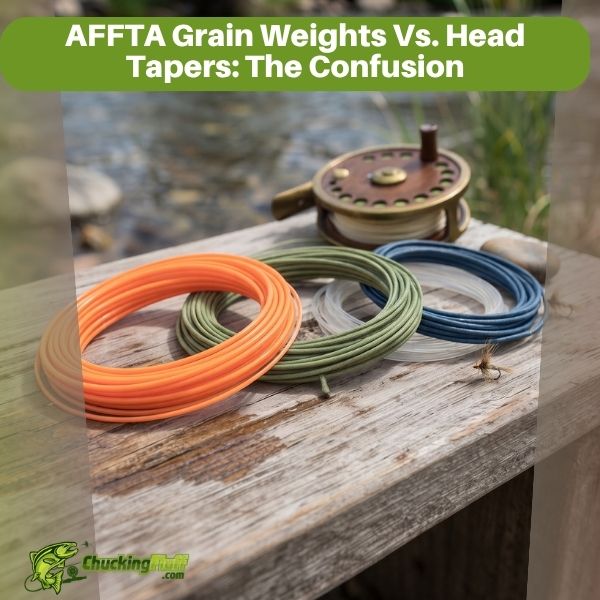
You’ve probably had this moment: you string up a brand-new “5-weight” line on your trusty “5-weight” rod, expecting the effortless loading you remember from a shop demo, and instead you get… something else. Maybe it feels sluggish. Maybe it feels like the rod tip is slapping the air instead of bending into it. You check the labels again. Everything matches. And yet something clearly doesn’t.
This isn’t user error, and it isn’t a defective line. It’s the predictable result of two different systems — a weight standard and a taper design — both hiding behind the same single number. Once you understand how they actually relate to each other, the mystery evaporates, and so does most of your line-matching frustration.
The Confusion Hiding in Plain Sight
Two Different Systems Wearing the Same Number
Here’s the core issue in one sentence: the number on a fly line tells you its total grain weight class, but it tells you almost nothing about where that weight sits along the line’s length. Two systems are at play — the AFFTA grain weight standard, which is about total mass, and the head taper, which is about mass distribution and geometry. A “5” from each system can describe lines that behave completely differently in the air and on the water, because one number is measuring a quantity and the other is shaping a curve.
Treating these as one single, interchangeable spec is where almost all the confusion starts.
What AFFTA Grain Weight Standards Actually Define
The Origins of the Standard
The American Fly Fishing Trade Association (AFFTA) — the successor to the older AFTM system — maintains an industry standard so that anglers have some common language for comparing lines across brands. Before this kind of standardization, buying a line was closer to guesswork, since there was no shared reference point for what “heavy” or “light” actually meant in numbers.
The 30-Foot Measurement Window
The standard works by weighing the first 30 feet of a fly line, not counting any level tip, and comparing that weight in grains against a published chart. Wherever that number falls determines the line’s class — a 4, a 6, an 8, and so on. It’s a deliberately simple system, and that simplicity is both its strength and its weakness.
The Grain Weight Ranges, Explained
Each class corresponds to a grain range rather than a single exact number, which means a line can sit at the light end or heavy end of its class and still legally wear the same label. A line built toward the top of the “5-weight” range and one built toward the bottom of that same range can differ by a meaningful number of grains — enough to feel like two different line weights in hand — while both are, technically, honest 5-weights.
What “Head Taper” Really Means
Front Taper, Belly, and Rear Taper Defined
While AFFTA grain weight tells you how much the front 30 feet weighs in total, taper design tells you how that weight is shaped. A line’s front taper is the gradual build from the thin tip up to full diameter; the belly is the thickest, heaviest section that carries most of the mass; and the rear taper (on a weight-forward line) steps back down to the thin running line. Two lines can hit the same total grain weight in that first 30 feet while distributing it completely differently — one with a short, punchy front taper concentrating mass close to the tip, another with a long, gradual taper spreading that same weight over a greater distance.
Head Length: Short, Medium, and Long
Head length matters just as much. A short, aggressive head loads a rod quickly at close range because the mass arrives fast and concentrated. A longer head spreads that load-building process over more line, which can feel smoother for roll casts and false casting but slower to fully engage a rod tip at short distances. Same grain class, same number on the box — genuinely different casting personality.
Why Two “5-Weight” Lines Can Be Wildly Different
Same Grain Total, Different Distribution
This is the crux of the whole issue: total weight and weight distribution are not the same thing, and a single number can’t communicate both. A 5-weight line engineered with a short, heavy front taper will load a rod’s tip section fast and hard at 20 feet. A 5-weight line with a longer, more gradual taper will feel like it needs more line out the tip before the rod really “feels” it. Both are correctly labeled. Both will frustrate you if you expected them to behave identically.
How Manufacturers Bend the Rules Within the Standard
Manufacturers know this, and many use it deliberately. It’s increasingly common to see lines marketed as, say, a “5-weight” that are intentionally built to the heavy end of that grain range — sometimes even slightly over it — specifically to help fast-action rods load better at short range. This isn’t cheating the standard; it’s designing within its tolerances to solve a real casting problem. But it does mean you can’t assume every “5” is created equal.
Why a “5-Weight” Rod Sometimes Wants More (or Less)
Rod Action and Load Requirements
A rod’s action — where it bends along its length — determines how much mass it needs moving through the guides before it flexes properly. Slower-action rods, which bend generously through the mid and lower sections, tend to load well with standard or even lighter grain weights, since less mass is needed to get that generous flex going. Fast-action rods, which stay stiff until near the tip, often need more mass, delivered faster, to load at all — especially at the short-to-medium ranges where most actual fishing happens.
The Rise of Intentionally Heavy “Standard” Lines
This is precisely why so many modern lines marketed as “5-weight” or “6-weight” are quietly built heavier than lines with the same label a decade ago. Rod design moved toward faster, stiffer actions, and line manufacturers responded by nudging grain weights upward within the legal range to keep those rods loading properly. The number stayed the same. The physical product changed underneath it.
Reading Between the Lines: Manufacturer Grain Charts
When Rod Companies Publish Grain Windows
The clearest path through all this confusion is when a rod manufacturer simply tells you the truth in numbers: a specific grain-weight window the rod was designed and tested around, independent of the line-weight label. When this information is available, use it — it cuts straight through the ambiguity of the number system entirely.
When They Don’t: How to Estimate It Yourself
When that data isn’t published, you’re working with less certainty, but not none. Casting a few different lines of the same nominal weight — ideally with noticeably different grain weights or taper designs — and paying attention to how quickly and smoothly the rod loads at your typical fishing distance will tell you more than any spec sheet. You can also measure a line’s actual grain weight yourself by cutting the first 30 feet and weighing it on a grain-calibrated scale, then comparing that figure against the AFFTA reference range for its class.
Practical Framework: Matching Grain Weight to Your Actual Rod
Step-by-Step Approach
- Identify your rod’s action — fast, moderate, or slow — either from the manufacturer’s description or by flexing it yourself.
- Look for a published grain window from the rod manufacturer before assuming the labeled line weight is gospel.
- If no grain data exists, start with the standard label and treat it as your baseline, not your final answer.
- Test a heavier and a lighter option within a half-line-weight range of the label, paying attention to how the rod loads at your actual fishing distances rather than on a long, open lawn.
- Trust the feel over the label once you’ve cast a couple of real options side by side — a rod that loads smoothly and a loop that stays tight is the real confirmation, not the number on the box.
Signs You’re Underlined or Overlined
If your rod feels stiff, whippy, or unresponsive at typical fishing distances, and you find yourself over-casting or forcing extra power into every stroke, you’re likely underlined — the line isn’t delivering enough mass for that action. If, on the other hand, the rod feels like it’s loading too early, your loops are wide and tailing, or the cast feels heavy and sluggish even at short range, you may be overlined.
Case Studies: Same Number, Different Outcomes
Fast-Action 5-Weight, Short-Range Dry Fly Rod
Picture a fast-action 5-weight built for technical dry fly fishing at 15 to 35 feet. This rod typically wants a line built toward the heavy end of the 5-weight grain range, often with a shorter front taper, so it loads quickly and delicately at close range without requiring an exaggerated casting stroke.
Fast-Action 5-Weight, Distance-Oriented Rod
Now picture a different fast-action 5-weight, this one built with distance and wind-fighting in mind. This rod may actually prefer a longer head and a line closer to the standard or even lighter end of the grain range, since the goal here is maintaining line speed and control over long, open casts rather than instant loading at short range. Same number stamped on the blank — genuinely different ideal line.
Conclusion
The number on your rod and the number on your line box were never meant to be the whole story — they’re a shared shorthand for two systems that measure fundamentally different things. AFFTA grain weight tells you total mass in the front 30 feet; head taper tells you how that mass is shaped and distributed. A “5-weight” rod doesn’t always want a true 5-weight line because rod action, taper design, and casting distance all interact with grain weight in ways a single number simply can’t capture. The fix isn’t complicated: look past the label, seek out actual grain data when it’s available, and trust how the rod loads in your hands over what’s printed on the blank. That’s how you stop chasing numbers and start matching gear that actually performs.
Frequently Asked Questions
1. Is AFFTA the same as the old AFTM standard?
Essentially yes — AFFTA is the modern successor organization that maintains the same core grain-weight classification system originally established under AFTM, so lines and rods labeled under either system are generally compatible in concept.
2. Can I just always overline a fast-action rod and be safe?
Not automatically — overlining helps many fast rods load better at short range, but rods specifically designed for distance casting can lose performance if overlined, so it’s worth testing rather than assuming.
3. Do grain weight differences matter more on short rods or long rods?
They tend to matter noticeably on both, but short rods used for close, technical work are especially sensitive to grain weight, since there’s less rod length available to compensate for a mismatch.
4. Why don’t all rod manufacturers just publish grain windows?
Partly tradition and partly marketing simplicity — the single-number system is easier for casual buyers to understand at a glance, even though it sacrifices precision for anglers who want an exact match.
5. Does head taper matter as much for sinking lines as floating lines?
Yes, arguably more so, since sinking lines add density to the equation alongside taper shape, meaning grain weight and distribution both play an even bigger role in how the line casts and behaves in the water.

How to Trout Fish with a Fly Rod – Part 5 the Fly Line Profile
How to Choose a Fly Line – Some advice for beginners

Essential Fly Fishing Vest And Pack Accessories Every Beginner Should Have
About Author
