
| Disclosure: Just to be open and honest the buttons and links you click on in the website will in most cases take you to another website where you can purchase the products I am reviewing. As an Amazon Associate I earn from qualifying purchases. |
Streamer Casting Tactics: How to Turn Over Heavy Flies
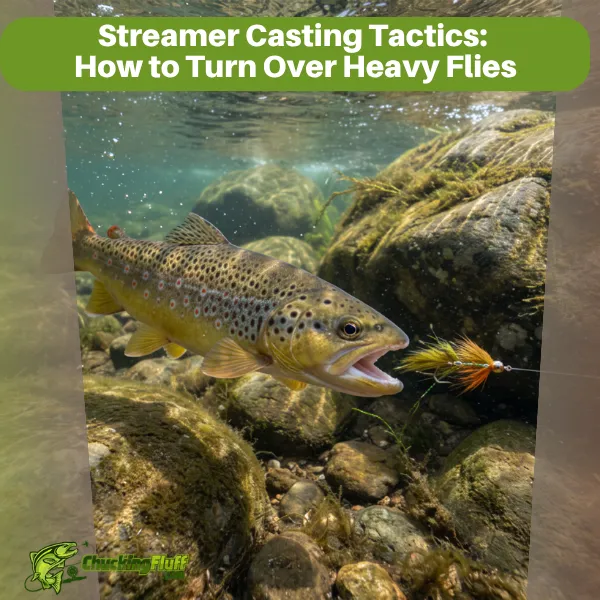
How to cast streamers without tangling comes down to two fixes: remove slack before every stroke, and open the loop so the heavy fly travels beside and above the line instead of through it. Pause longer on the backcast, accelerate smoothly, stop the rod high, and use a short, stiff leader.
Why does a heavy streamer tangle your leader in the first place?
A heavy streamer tangles your leader because the fly outruns the loop and slack in your stroke lets it cross the line. A dry fly weighs almost nothing, so the line carries it wherever the loop goes. A weighted fly pulls on the end of the leader, changes the shape of the loop, and swings into whatever is nearest.
Two separate problems produce most tangles:
- A tailing loop. The rod tip dips during the stroke, the line’s top leg sags below the bottom leg, and the two cross. The fly and leader then wrap around the line, which is what a wind knot is. Heavy flies make this worse because they load the rod more and punish any jerk in the stroke.
- Slack. Any slack between the rod tip and the fly means the stroke spends its first inches taking up that slack rather than loading the rod. You then compensate by snapping the cast harder, and that late burst of power is what creates the tailing loop.
A third cause shows up on the forward cast. If the loop is too tight, the fly travels on nearly the same path as the line and hits it. Opening the loop gives the fly a different path.
The fix is a handful of changes to your stroke, loop and leader, in that order. Which streamer to tie on is a separate question, and this article covers casting only.
What should you change in your stroke before touching your gear?
Change your stroke first, because a smooth stroke fixes most streamer tangles without spending a cent. Buying a new leader will not help if the rod tip still dips mid-cast.
Work through these changes in order:
- Take out the slack before you start. Strip in line until it is straight from the rod tip to the fly, with the rod tip low. If you lift into the backcast with line sagging on the water, the rod has nothing to load against.
- Lengthen your pause on the backcast. A heavy fly takes longer to straighten behind you. Wait until the line has fully unrolled and you feel a slight tug at the rod tip, then start forward. Starting early is the most common reason a beginner’s weighted fly whips around.
- Accelerate smoothly and stop crisply. Build speed gradually through the stroke and stop the rod firmly at the end. A burst of power at the start of the forward cast produces the tailing loop.
- Use a longer, slower stroke. Heavy flies reward a wide arc and a patient pace. A short, snappy stroke that works for a dry fly gives a heavy fly too little time to load the rod.
- Cut your false casts. Each extra pass is another chance to build slack or dip the tip. With a weighted fly, one backcast and one forward cast, then shoot the line, is usually enough.
Practice these on open grass or a quiet stretch of water with a heavy fly that has the hook point cut off or a yarn stand-in, not at the first run you want to fish.
How do you open up your loop so the fly doesn’t hit the line?
You open the loop by moving the rod through a slightly wider arc and stopping it higher, which spreads the top and bottom legs of the line apart. A wider loop gives the heavy fly room to pass below the upper leg without touching it.
Dry fly casters are often taught to make tight, narrow loops because they cut through wind and look tidy. That habit works against you with a streamer. The fly and the leader are traveling at the tip of the loop, and in a tight loop the two legs are only a few inches apart. A small wobble in the rod tip is enough to bring them together.
Here is what to adjust:
- Stop the rod higher on the forward cast. Stopping it lower throws the loop downward and makes the fly dive into the line. A stop around the point where the rod is pointing slightly above eye level sends the fly out and up, then lets it fall.
- Move the rod tip in a straight line. Imagine the tip tracing a flat path through the stroke. If it scoops down at the start of the forward cast, it dips and creates the crossing loop.
- Aim above where you want the fly to land. Cast at a target a few feet above the water so the line unrolls in the air before dropping.
- Try an off-shoulder cast. Tilt the rod a little to the side so the fly passes outside your shoulder rather than over your head. That takes the fly away from your line and also away from your face.
An off-shoulder cast is worth the practice. It lets you open the loop while keeping the heavy fly on a path that does not cross the line.
Does your leader length and stiffness make streamers harder to turn over?
Yes. A leader that is too long, too soft or too thin gives a heavy fly nothing to push against, so it folds over at the end of the cast and lands in a pile. A shorter, stiffer leader transfers the energy of the stroke straight to the fly.
Turnover is the process of the line, leader and fly unrolling in a straight line at the end of the cast. A dry fly and a long, fine leader turn over gently because there is little weight to carry. A heavy streamer needs a leader built differently.
|
Leader feature |
Works against you |
Works for you |
|---|---|---|
|
Length |
Very long, like a dry fly leader |
Shorter, roughly six to eight feet for most beginner streamer fishing |
|
Butt section |
Thin, soft, or mismatched to the fly line tip |
Thick and stiff enough to continue the line’s energy |
|
Tippet |
So fine it cannot carry the fly’s weight |
Matched to the fly size and weight |
|
Knots |
Many knots, tied badly, catching on guides |
Few, clean knots |
Use the following as a guide:
- Shorten the leader if it is currently as long as your rod or longer. A shorter leader gives the fly less room to flop around.
- Choose a stiffer butt section. A heavy mono butt close to the diameter of the fly line tip continues the energy of the line to the fly.
- Match the tippet to the fly. A thin tippet on a heavy, bulky streamer collapses at the end of the cast. Move up in strength until the fly turns over, while still being able to tie a clean knot.
- Check your line and rod balance. If the rod feels overloaded with the fly, the line weight and rod may not suit heavy flies. The setup guides on this site cover rod and line matching.
Leader changes help, but they are the third fix. A stiffer leader on top of a dipping rod tip still ends up in knots.
How do you cast a weighted fly safely when the wind or a tight spot is against you?
Move the fly away from your body and keep the cast short and low. Wind and tight spots push a heavy fly into you or the line, so choose a cast that keeps it on the downwind side and shortens the time it spends in the air.
For wind:
- Keep the wind on your casting arm’s opposite side. If the wind is blowing toward your casting arm, the fly drifts into you. Turn your body or switch to an off-shoulder cast so the wind pushes the fly away.
- Lower the cast. Sidearm casts keep the line under the wind and reduce the chance of a gust pushing the loop into itself.
- Shorten the line you carry. A shorter line in the air gives the wind less to work on and gives you more control.
- Slow down. Gusts make most people hurry the stroke, and hurrying brings back the tailing loop.
For tight spots, like brush behind you or a narrow bank:
- Use a roll cast. It needs no backcast at all, so the fly never goes behind you. Make sure the line is straight in front before you start, then drive forward and stop.
- Use a shorter, slower cast and let the fly drop onto the water rather than forcing distance.
- Wear eye protection. A heavy hooked fly that comes back at you can do real harm, and sunglasses or clear glasses are a cheap precaution. A cap helps too.
If a cast is going wrong, stop and strip the line back in. Starting over with a straight line takes a few seconds, and untangling a wind knot on the water takes far longer.
What does a good streamer cast look like, and how do you spot a bad one?
A good streamer cast shows a smooth, open loop that unrolls fully, with the fly landing at the end of a straight leader. A bad one shows a sagging or crossing loop and a leader piled up near the fly.
Check these signs against what you see:
|
What you see |
What it means |
What to change |
|---|---|---|
|
Line unrolls flat, leader straightens, fly lands last |
Good turnover |
Keep doing it |
|
Top leg of the loop sags below the bottom leg |
Tailing loop from a dipping rod tip or sudden power |
Smooth the acceleration and keep the tip path straight |
|
Leader and fly land in a heap |
Not enough energy reaching the fly |
Shorten and stiffen the leader, lengthen the pause |
|
Fly snaps behind you with a crack |
Starting forward too early or too hard |
Wait for the backcast to straighten |
|
Wind knots near the fly |
Crossing loop, often from slack |
Take out slack and open the loop |
|
Fly hits the line or rod |
Loop too tight |
Stop the rod higher and widen your arc |
Check the leader after every few casts. A wind knot weakens the tippet at the exact point where it is tied, so pick it out or replace the section before you cast again.
5 FAQs about casting streamers
Why does my streamer keep wrapping around my fly line?
The loop is probably crossing. Either the rod tip is dipping during the stroke or you are using too much power too early. Slow down, lengthen the pause on the backcast and smooth the acceleration.
Do I need a different rod to cast a heavy streamer?
Not necessarily. Many tangles come from the stroke, not the rod. If the rod feels overloaded even after you fix your stroke and leader, the line weight and rod may be mismatched for the fly you are using.
Should I use a shorter leader for streamers?
Usually, yes. Shorter, stiffer leaders turn over a heavy fly more reliably than the long, fine leaders used for dry flies. Start at roughly six to eight feet and adjust from there.
How many false casts should I make with a weighted fly?
As few as you can. One backcast and one forward cast is often enough. Each extra false cast adds a chance for slack or a dipping tip.
What is the safest way to cast a heavy fly?
Use an off-shoulder or sidearm cast that keeps the fly away from your head, wear eye protection, and pause on the backcast so you know where the fly is before you go forward.
Which habit should you fix first?
Fix the slack first. Strip in line until it is straight to the fly, then pause on the backcast until the line has fully straightened. Those two habits remove the most common cause of tangles, and they cost nothing.
After that, work through the order in this article: smooth the acceleration, open the loop by stopping the rod higher, shorten and stiffen the leader, and switch to an off-shoulder cast when wind or brush gets in the way. Change one thing at a time so you can tell which change helped.
Pick your first streamer with the beginner’s guide to nymphs, dries and streamers, then take the stroke changes from this article to the water.

Essential Fly Fishing Vest And Pack Accessories Every Beginner Should Have

Tying Your Own Flies: A Comprehensive Beginner’s Guide

What Accessories are needed to Fly Fish? A Beginners Guide
About Author
