
| Disclosure: Just to be open and honest the buttons and links you click on in the website will in most cases take you to another website where you can purchase the products I am reviewing. As an Amazon Associate I earn from qualifying purchases. |
Nymphs, Dries, and Streamers: The Beginner’s Guide to Choosing a Fly
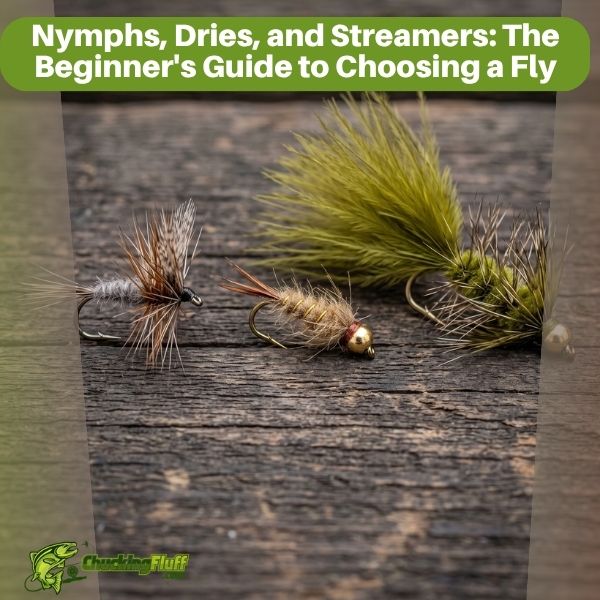
Standing in front of a fly bin at the local shop is one of the more quietly terrifying moments in fly fishing. There are hundreds of tiny patterns pinned into foam rows, half of them look like variations of the same bug, and the price tags make you nervous about picking wrong. Nobody hands you a decoder ring on the way in.
Here’s the good news: almost every one of those flies falls into one of three categories, and once you understand what each category is for, the fly bin stops being a wall of confusion and starts being a short decision tree.
Why Beginners Freeze Up at the Fly Bin
The overwhelm isn’t really about the flies. It’s about information with no structure behind it. A beginner looking at forty dry fly patterns has no way to know that most of them do roughly the same job, just in slightly different sizes and colors for slightly different bugs.
Fly shops and fly guides often make this worse by listing specific patterns first: Adams, Woolly Bugger, Pheasant Tail, Elk Hair Caddis. Those names mean nothing until you know what category they belong to and what that category is supposed to accomplish. Learn the three categories first, and the individual pattern names become details you pick up later, not a wall you have to memorize before you’re allowed to fish.
The three categories are dry flies, nymphs, and streamers. Each one answers a different question about where the fish are feeding and what they’re feeding on. Match the category to the water in front of you, and you’ve already made the hardest decision of the day.
Dry Flies: What to Tie On When Fish Are Rising
Dry flies float on top of the water and imitate adult insects, the ones that have already hatched and are sitting on the surface or fluttering just above it. This is the fly category most people picture when they imagine fly fishing: a small, delicate pattern drifting on the current, a trout rising to sip it off the top.
The tell that it’s dry fly time is visual and obvious once you know to look for it. You’ll see rings on the water where fish are rising, or you’ll see actual bugs in the air or on the surface. If you’re standing at the water’s edge and you see fish dimpling the surface repeatedly, that’s about as clear a signal as this sport gives you. Tie on a dry fly that roughly matches the size and color of what’s hatching, and you’re in business.
The catch is that dry fly fishing only works when fish are actively feeding on top, and that’s a smaller percentage of the time than beginners expect. Fish spend far more of their day feeding below the surface, which is exactly why the next category exists.
Nymphs: The Everyday Workhorse Under the Surface
Nymphs imitate the underwater, immature stage of aquatic insects, the stage before they hatch into the flying adults that dry flies imitate. This stage can last months, compared to the hours or days an adult insect spends on the surface. That math alone explains why nymphs account for most of what trout actually eat on any given day.
This is the category to default to when you don’t see rising fish and you’re not sure what else to try. No visible hatch, no surface activity, nothing obvious happening above the waterline: tie on a nymph and get it down near the bottom, where the fish are holding and feeding most of the time.
Nymphing also tends to be more forgiving for beginners than dry fly fishing, because you’re not trying to match a precise hatch or get a drag-free drift on the surface. You’re presenting something subsurface that looks generally buggy, drifting naturally with the current. It’s less glamorous than watching a trout rise to a dry fly, but it catches more fish, more consistently, across more conditions.
Because nymphing is so central to beginner success, it’s worth learning properly rather than picking it up by accident. If you want a deeper walkthrough on rigging, depth, and drift, this guide to nymphing techniques covers it step by step.
Streamers: Throwing Something Big to Trigger a Strike
Streamers are the odd category out. Where dry flies and nymphs imitate insects at different life stages, streamers imitate bigger prey: minnows, leeches, crayfish, sometimes smaller fish of the same species. They’re larger, often flashier, and fished with movement instead of a passive drift.
Streamer fishing isn’t about matching a hatch at all. It’s about triggering an aggressive, predatory response. You cast it out, strip it back in short pulls, and you’re trying to provoke a strike rather than present a convincing meal that a fish mistakes for the real thing. This makes streamers the go-to choice when the water is off-color, when light is low at dawn or dusk, or when nothing else is producing and you want to try something that works on instinct rather than subtlety.
Streamers also tend to catch the larger fish in a given stretch of water, since bigger predatory trout are more willing to chase down a sizeable meal than a beginner feeding on tiny insects. If dry flies and nymphs are about patience and precision, streamers are about covering water and provoking a reaction.
A Simple Rule for Picking the Right Category on the Water
Here’s the decision tool, stripped down to its simplest form:
- See fish rising or bugs in the air? Tie on a dry fly.
- No surface activity, no clear hatch? Start with a nymph.
- Off-color water, low light, or nothing else working? Try a streamer.
This order isn’t arbitrary. It follows the order of likelihood on most trout water, most of the time. Surface activity is the easiest signal to read but the least common condition. Subsurface feeding is happening constantly, which is why nymphs are the default when you’re not sure. Streamers are the experiment you reach for when conditions are poor or you want to change the game entirely.
A simple habit that saves beginners a lot of wasted time: spend the first five minutes at the water just watching before you cast anything. Look for rises, look for bugs, look at water clarity. The water is telling you which category to start with before you ever tie on a fly.
Stocking a Starter Fly Box Without Overspending
You don’t need forty patterns in three sizes each to get started. A basic box built around the three categories, with a few reliable patterns and a couple of sizes in each, covers the vast majority of situations a beginner runs into.
A reasonable starting point:
- A handful of general-purpose dry flies in a couple of common sizes, in natural colors that could pass for several different insects at once.
- A selection of weighted nymphs, since getting the fly down to where the fish are feeding matters as much as the pattern itself.
- Two or three streamer patterns in different sizes, since streamer fishing is as much about size and movement as it is about exact imitation.
Ask whoever’s behind the counter at a local fly shop what’s working on the water you’re planning to fish. They see what’s getting caught on local water week to week, and a few targeted recommendations will serve you better than a box stuffed with patterns that don’t match anything nearby.
It’s also worth remembering that the fly only matters if the rest of your setup can present it properly. A rod and reel that’s fighting you on every cast makes it hard to judge whether a fly choice was wrong or whether the cast itself was the problem. If you’re still fishing a combo that came with compromises, it might be worth reading about the benefits of upgrading your fly combo before you spend more on flies than on the gear that delivers them.
Ready to Go Deeper on Nymphing Techniques
Once you’re comfortable reading water and reaching for the right category, nymphing is where most of your practical fishing time will go, simply because fish feed subsurface more often than they rise or chase. Getting good at depth, drift, and indicator reading will do more for your catch rate than any single fly pattern will.
If that’s the skill you want to build next, the full breakdown is here: Fly Fishing Nymphing Techniques: A Beginner’s Guide. It picks up exactly where this article leaves off, with the specifics on rigging and presentation that turn “tie on a nymph” into a method you can actually rely on.
Common Mistakes When Using Leaders And Tippets
Fly Fishing Lines Explained – A Guide for the Beginner
Essential Flies For Every Fly Fishing Angler
About Author
