
| Disclosure: Just to be open and honest the buttons and links you click on in the website will in most cases take you to another website where you can purchase the products I am reviewing. As an Amazon Associate I earn from qualifying purchases. |
Different Types Of Vests And Packs And Their Pros And Cons
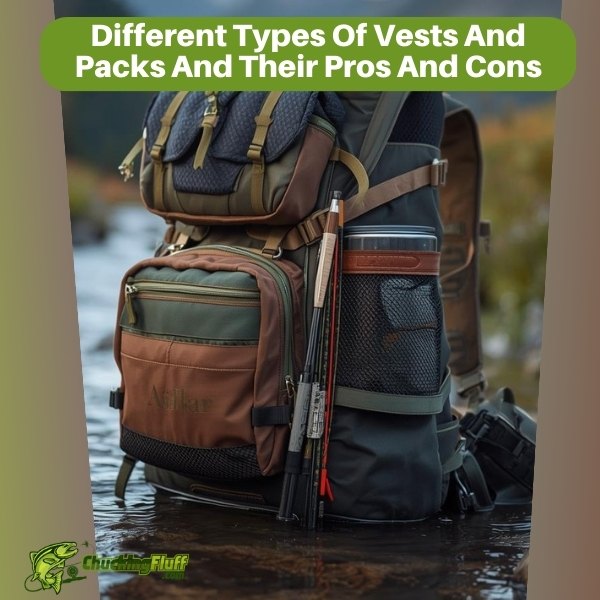
Picture this: you’ve hiked three miles into a remote canyon, the river is singing, trout are rising like crazy… and you can’t find your size 18 BWO because everything in your pack is a tangled mess. We’ve all been there. The truth? Your vest or pack can make or break a day on the water.
Let’s fix that today with the most in-depth, no-BS guide to every major style of fly fishing vest and pack available.

- FISHING WORKSTATION RIG: This heavy-duty chest pack has a front pocket that zips down into a compact and easy-to-use workstation. It comes with a tippet (leader) spool holder and a hook and loop closure on the chest's face for positioning fly patches.
- LARGE CHEST PACK: The large main compartment inside this waterproof chest bag measures 8" x 3.25" and fits two fly/tackle boxes.
- VERSATILE: This pack has two internal mesh accessory pockets, an external mesh pocket for small terminals or leaders, and a web tab for attaching retractors for line nippers or hemostats. The D-rings are for attaching tippet holders and other tools.
- COMFORTABLE AND SECURE: This pack fits comfortably and stays in place when you're using it thanks to a padded, adjustable neck and waist strap. The neck strap comes with a fishing net D-ring.
- ALLEN CO: We share your passion for the great outdoors. Our unwavering dedication lies in crafting superior hunting, shooting, and archery gear that combines quality and value.

Quick Post Navigation
- Why Your Choice of Vest or Pack Actually Matters More Than You Think
- 1. Traditional Fly Fishing Vests – The Old-School Workhorse
- 2. Chest Packs – The Minimalist’s Dream
- 3. Sling Packs – The One-Shoulder Revolution
- 4. Hip Packs (Lumbar Packs) – Low and Close to the Body
- 5. Backpack-Style Fly Fishing Packs – For the Long Haul
- 6. Hybrid Designs & Convertible Systems
- Key Features to Look for in ANY Fly Fishing Pack
- How Water Type Changes Everything
- Real-World Testing: What Actually Holds Up After 100+ Days
- Conclusion: There’s No Single “Best” – Only the Best for YOU
- Frequently Asked Questions (FAQs)
Why Your Choice of Vest or Pack Actually Matters More Than You Think
Most anglers obsess over rods, reels, and fly patterns (fair), but the thing strapped to your body for 8–12 hours a day? That’s what quietly controls your comfort, efficiency, and even how many fish you catch. A bad system means constant fiddling, sore shoulders, wet gear, and missed opportunities. The right one feels like an extension of your body.
The Evolution from Classic Vest to Modern Packs
Twenty years ago, there was only “the vest.” Today we have chest packs, slings, hip packs, technical backpacks, and wild hybrids. Each solves different problems born from wading deeper, hiking farther, and wanting to carry less junk.
1. Traditional Fly Fishing Vests – The Old-School Workhorse
Yes, they still exist, and yes, plenty of guides and old timers swear by them.
Key Features of a Classic Vest
- 14–30 pockets (front, back, inside)
- Mesh body for breathability
- D-rings everywhere
- Often a built-in rod holder loop on the back
- Rear “stuff” pocket for rain jacket or lunch
Pros of Traditional Vests
- Everything is instantly reachable without taking anything off
- Outstanding organization if you’re disciplined
- Even weight distribution across both shoulders
- Usually the cheapest option
- You look like a proper fly fisherman (subjective pro)
Cons of Traditional Vests
- They get HEAVY when fully loaded (8–12 lbs is common)
- Hot as heck in summer – mesh only helps so much
- Pockets sag and swing when you bend over
- Not great if you wear a backpack or wade chest-deep
- Modern materials have left cotton/mesh vests in the dust
Best Scenarios for a Traditional Vest
Spring creeks, park-and-wade meadow streams, or any day you’re fishing within 200 yards of the truck and want every possible tool at your fingertips.
2. Chest Packs – The Minimalist’s Dream
Think of these as a big “bib” that sits on your chest and usually attaches to your wader suspenders or a neck strap.
How Chest Packs Actually Work on the Water
You flip the pack up to access the main compartment, dig for flies, then drop it back down. Most have external tippet spools and tool docks.
Pros of Chest Packs
- Extremely light (often under 1.5 lbs)
- Zero interference with casting motion
- Perfect when you pair them with a small hip or backpack
- Stay on even when you strip down to a T-shirt in summer
- Great for bike-in or run-and-gun fishing
Cons of Chest Packs
- Limited capacity – you’ll run out of space fast
- Neck/shoulder fatigue on very real after 6+ hours
- Not ideal for rain (unless fully waterproof model)
- Can bounce annoyingly if not dialed in perfectly
Top Chest Pack Recommendations
- Fishpond Canyon Creek Chest Pack
- Umpqua ZS2 Overlook 500
- Patagonia Stealth Atom (super minimal)
3. Sling Packs – The One-Shoulder Revolution
The sling pack is the single biggest gear innovation of the last decade.
Why Sling Packs Exploded in Popularity
You wear it like a quiver – slides from back to front in one motion. No need to take it off.
Pros of Sling Packs
- Perfect balance of capacity and mobility (8–18 L typical)
- Easy one-handed swing to front for access
- Works great with chest-deep wading
- Ambidextrous designs now common
- Tons of workstation features (fold-down tables, magnetic closures)
Cons of Sling Packs
- One-shoulder carry can cause fatigue on very long days
- Some cheaper models dig into your neck
- Can swing forward and hit your rod butt when casting (rare with good fit)
- Harder to pair with a backpack
Swinging a Sling Pack vs. Spinning – What Feels Better?
If you’re constantly moving and covering miles of river, the sling is hard to beat. It feels like cheating.
4. Hip Packs (Lumbar Packs) – Low and Close to the Body
The “fanny pack” went fishing and never came back the same.
The Resurgence of the Fanny Pack (But Cool This Time)
Modern hip packs are sleek, waterproof, and ride low on your hips instead of your belly.
Pros of Hip Packs
- Lowest center of gravity = best balance while wading slick rocks
- Zero shoulder or neck strain
- Easy to sit on a rock or log without removing
- Surprisingly large capacity (8–15 L)
- Look great off the water too (airport-friendly)
Cons of Hip Packs
- Belt can ride up when you squat or climb banks
- Harder to access while wearing thick waders
- Not ideal if you already wear a wide wading belt
- Limited upper-body tool attachment
When a Hip Pack Beats Everything Else
Technical tailwaters, summer small-stream hopping, or any day you’re climbing in and out of the river constantly.
5. Backpack-Style Fly Fishing Packs – For the Long Haul
These range from 20 L day packs to 40+ L overnight monsters.
Day-Pack vs. Multi-Day Technical Packs
Day packs (Patagonia Stealth, Simms Dry Creek, Fishpond Thunderhead)
Multi-day (Simms G3 Guide Backpack, Umpqua Surveyor 2000 ZS2)
Pros of Fishing Backpacks
- Unlimited capacity – cameras, lunch, layers, extra reels
- Best weight distribution for 5+ mile hikes
- Often fully submersible or highly water-resistant
- Hydration bladder compatible
Cons of Fishing Backpacks
- You have to take them off to get anything
- Can make you sweat like crazy in summer
- Overkill for a 2-hour evening session
- Expensive
6. Hybrid Designs & Convertible Systems
Brands now make vests that zip into hip packs, slings that convert to chest packs, and backpacks with removable “brain” modules. Examples:
- Orvis PRO Vest (vest + detachable hip pack)
- Fishpond Switchback Pro (belt system that accepts sling or chest modules)
These are brilliant if you refuse to choose just one style.
Key Features to Look for in ANY Fly Fishing Pack
Material & Waterproofing
500D Cordura + TPU coating is the sweet spot. Fully submersible roll-tops (Fishpond Thunderhead, Simms Dry Creek) if you swim a lot.
Pocket Layout & Organization
Magnetic pockets, hypoallergenic fly patches, color-coded zippers, and tippet bar docks save sanity.
Comfort & Weight Distribution
Padded straps, breathable back panels, and load lifters matter more than you think.
Rod Holder & Net Attachment Options
Magnetic net holders and collapsible rod tubes built-in are game-changers.
How Water Type Changes Everything
Small Streams & Brushy Rivers
Hip pack or small sling. Anything bigger snags on every branch.
Big Western Freestones
Sling or chest + hip pack combo. You’re moving fast and wading deep.
Saltwater Flats & Boat Fishing
Waterproof backpack or large sling. Sun protection and capacity rule.
Real-World Testing: What Actually Holds Up After 100+ Days
After guiding and personally beating the snot out of dozens of packs since 2016, here’s the hierarchy I’ve settled on:
- Primary pack: 12–15 L sling (currently Fishpond Summit Sling 2.0)
- Backup: Waterproof hip pack for summer small streams
- Long-hike weapon: 28 L technical backpack with net slot
- Nostalgia drawer: One beat-up Orvis vest from 2004 that still gets used on easy days
Conclusion: There’s No Single “Best” – Only the Best for YOU
If you fish short sessions close to the car and love having 47 pockets, rock a traditional vest.
If you cover miles of river and hate neck strain, grab a sling or hip pack.
If you’re hiking into wilderness or shooting photos, go full backpack.
Match the tool to the job, keep the weight under 7–8 lbs loaded, and organize ruthlessly. Do that and you’ll spend more time fishing and less time swearing at your gear.
Tight lines, dry gear, and may your pack never flip upside down in the current.
Frequently Asked Questions (FAQs)
Q1: Are fly fishing vests still worth buying today?
A: Absolutely — if you fish gentle water, short days, and love instant access to everything. Modern lightweight vests (Simms Tributary, Orvis PRO) fixed most of the old heat/sag issues.
Q2: What’s the most comfortable pack for all-day wading?
A: A well-fitted sling pack (Fishpond Summit, Patagonia Stealth Atom) or a large waterproof hip pack (Simms Waypoints) usually wins for 8–12 hour days.
Q3: Can I use a regular hiking backpack for fly fishing?
A: You can, but you’ll hate life. Regular packs lack fly-specific organization, net slots, and quick-access workstations. Spend the extra on a fishing-specific bag.
Q4: How much should I expect to spend on a quality pack?
A: $120–$250 gets you something that will last 5–10 years with heavy use. Cheap $60 specials fall apart in one season.
Q5: Sling pack left shoulder or right shoulder?
A: If you’re right-handed, most prefer the strap over the left shoulder so the pack swings to your left side (away from the rod). But try both — modern ambidextrous designs make it easy.
Last update on 2026-04-07 / Affiliate links / Images from Amazon Product Advertising API
This product presentation was made with AAWP plugin.

Improving Your Fly Fishing Skills: Practice And Patience

Mastering the Art: Dry Fly Fishing Tips for Success

Do You Wear Wading Boots With A Float Tube?
About Author
