
| Disclosure: Just to be open and honest the buttons and links you click on in the website will in most cases take you to another website where you can purchase the products I am reviewing. As an Amazon Associate I earn from qualifying purchases. |
Double Taper (DT) Vs. Weight Forward (WF): The No-Nonsense Guide For River & Stillwater Anglers
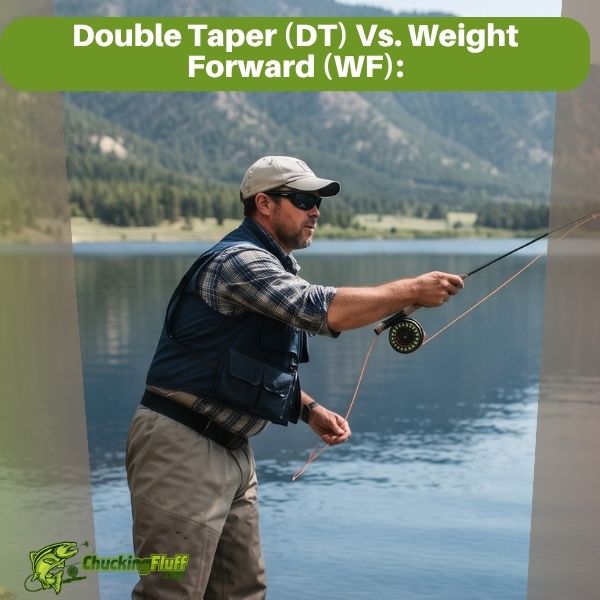
Double Taper (DT) vs. Weight Forward (WF): The No-Nonsense Guide for River & Stillwater Anglers
Ask five anglers whether you should fish a double taper or a weight forward line, and you’ll get five confident, contradictory answers — usually delivered with the certainty of someone quoting scripture. The truth is less dramatic and far more useful: both tapers are good tools, they’re just built for different jobs, and the “right” one depends entirely on what water you’re fishing and how you like to present a fly.
Let’s cut through the campfire debate and look at what’s actually happening in these two line designs — and which one deserves a spot on your reel.
Why This Debate Refuses to Die
A Quick Note on What “Taper” Actually Means
Before we pick sides, let’s define the battlefield. “Taper” refers to how the diameter — and therefore the mass — of a fly line changes along its length. Every fly line has a level tip, a taper that builds up to the “belly” (the thick, heavy section that carries most of the line’s weight), and then either another taper or a level running line behind it. Where that mass sits, and how it’s distributed, determines how the line loads a rod, how it turns over a leader, and how it behaves once it’s lying on the water.
DT and WF are simply two different answers to the same question: where should the weight go?
Double Taper Lines Explained
The Anatomy of a DT Line
A double taper line is symmetrical. It tapers up from a thin front tip, holds a long, gently graduated belly through the middle, and then tapers back down to a thin tip at the other end — mirror images of each other. There’s no thick head concentrating mass in one spot; the weight is spread out gradually and evenly across a long stretch of line.
What DT Lines Are Genuinely Good At
That even mass distribution is the whole personality of a DT line. Because the weight isn’t bunched up front, DT lines tend to lay down on the water with a softer, quieter presentation — genuinely useful when you’re casting to a spooky trout sipping midges in slow, clear water. They also roll cast beautifully, since a long, evenly weighted belly keeps unrolling smoothly without the abrupt hinge point you sometimes get with a WF head-to-running-line junction. And they mend like a dream: with a long belly still out past the rod tip, you’ve got plenty of “grip” on the water to reposition line without yanking your fly out of the drift.
Where DT Lines Fall Short
Here’s the trade-off: without a concentrated head to carry momentum forward, DT lines struggle to build the same line speed. Casting a DT line a long way, especially into wind, feels like pushing a wheelbarrow uphill — it’s doable, but it takes more false casts and more effort than it should. Distance work and windy days are simply not this line’s home turf.
Weight Forward Lines Explained
The Anatomy of a WF Line
A weight forward line front-loads its mass. The first 30 to 40 feet (roughly) holds a thick, heavier “head” — sometimes with an aggressive front taper — followed by a rapid step-down to a thin, light running line for the remainder of the length. Think of it as a bullet: a substantial mass up front pulling a thin tail behind it.
What WF Lines Are Genuinely Good At
That concentrated head is a distance and wind-fighting machine. Once you get the head moving, it carries momentum through the air and pulls the skinny running line out after it with minimal resistance, letting you shoot line and cover real distance with fewer false casts. It’s also the more forgiving option for beginners and for punching heavier or wind-resistant flies — streamers, weighted nymphs, bushy stillwater patterns — because the head has enough mass to power through air resistance that would stall out a DT line.
Where WF Lines Fall Short
The cost of that front-loaded design shows up at close range and in delicate situations. Because so much of the weight is concentrated in a short head, WF lines can land with more authority — sometimes more splash — than a DT line at the same distance, which matters when you’re presenting to line-shy fish in skinny water. Roll casting is also a bit less graceful, since the transition from thick head to thin running line can create a hinge point rather than a smooth, continuous unroll.
Head-to-Head: How Each Line Behaves in the Real World
Roll Casting and Short-Range Delicacy
If your fishing involves a lot of tight, brushy water where a full backcast isn’t an option, DT’s long, evenly distributed belly is going to roll cast more smoothly and consistently. WF can still roll cast, of course — but it’s less naturally suited to it, and you’ll notice the head “hinging” rather than unrolling in one continuous loop.
Distance, Wind, and Line Speed
Flip the scenario to open water, a stiff breeze, or a fish rising 60 feet away, and WF takes the clear advantage. The concentrated head generates the line speed and momentum needed to punch through wind and carry a longer cast with less physical effort. Trying to muscle a DT line that same distance is possible, but it’s a workout, not a technique.
Mending and Line Control on Moving Water
Upstream Mends
DT lines shine here. Since the belly extends well past the rod tip during a typical drift, there’s more evenly weighted line on the water to grab and reposition. An upstream mend with DT tends to move the line without disturbing the fly nearly as much, because you’re lifting and repositioning a gradually tapered mass rather than fighting a sudden transition point.
Downstream Drifts and Belly Control
On longer downstream drifts, that same long belly can work against you — more line on the water means more surface area for current to grab and start dragging your fly. WF lines, with more of their length as thin, low-friction running line during a typical drift, can actually resist drag a bit better once the initial head is out and the leader’s doing the work.
River Fishing: Which Taper Actually Wins
Small to Medium Freestone Streams
On tight, technical trout streams where most of your casts are inside 30 feet, drag-free drifts matter more than raw distance, and roll casts around streamside brush are a daily occurrence — DT is very hard to beat. The delicate presentation and superior mending control play directly to the strengths of a small-stream game.
Big Rivers and Long Drifts
On big rivers — think broad Western tailwaters or larger freestone systems where 50-plus foot casts and wind are part of the daily routine — WF’s distance and line-speed advantages start to matter more than DT’s delicacy. You’ll cast farther with less fatigue, and you’ll punch through wind that would otherwise eat up your day.
Stillwater Fishing: Which Taper Actually Wins
Bank Fishing and Short-Game Presentations
Fishing close to the bank for cruising fish, especially with small dries or subtle nymph presentations, plays to DT’s soft-landing strengths in much the same way technical trout streams do.
Float Tube and Boat Fishing at Distance
But stillwater fishing from a boat or float tube, especially blind-casting streamers or long leaders to searching fish, is a different animal entirely — and here, WF’s ability to cover water fast and cut through open-water wind makes it the more practical daily driver for most stillwater anglers.
The Economics of DT: The Reversible Line Advantage
Here’s a genuinely underrated DT perk that has nothing to do with casting mechanics: because the line is symmetrical, you can reverse it on the reel once one end wears out from use, effectively doubling its usable lifespan. That’s real value for anglers who fish often and don’t want to replace a line every season. WF lines don’t offer this benefit — once the head end is cracked or worn, that’s it, since the running line end isn’t built to cast.
Making the Call: A Decision Framework
If you’re still torn, ask yourself these questions:
- Where am I fishing most often? Tight streams and technical presentations lean DT; open water and distance lean WF.
- What flies am I typically throwing? Small dries and delicate nymph rigs favor DT; streamers, heavier nymphs, or wind-resistant stillwater patterns favor WF.
- How much backcast room do I usually have? Limited room and frequent roll casting favor DT.
- Do I fish enough to want a reversible line? If cost-per-season matters to you, DT’s reversibility is a real, practical edge.
- Am I a newer caster who wants forgiveness? WF is generally easier to learn on and more forgiving of casting stroke inconsistencies.
Many experienced anglers who fish varied water end up owning both — a DT on a small-stream setup and a WF on a rod dedicated to bigger rivers or stillwaters — rather than treating this as a permanent, one-size-fits-all decision.
Conclusion
There’s no universal winner in the DT versus WF debate, and anyone who tells you otherwise is fishing a narrower slice of water than they realize. Double taper lines reward you with delicate presentations, superior mending, and graceful roll casts — ideal for small streams, technical trout, and situations where subtlety matters more than distance. Weight forward lines reward you with distance, wind-punching power, and forgiving line speed — ideal for big rivers, open stillwater, and anyone throwing bulkier flies. The smartest move isn’t picking a side; it’s matching the taper to the water and technique in front of you, and building a line collection that reflects the actual variety of your fishing rather than a single, dogmatic preference.
Frequently Asked Questions
1. Can I use a DT line for streamer fishing?
You can, but it’s not ideal — DT lines lack the concentrated mass needed to efficiently turn over bulky, wind-resistant streamer patterns, so you’ll likely find yourself working harder for the same result a WF line would deliver more easily.
2. Is WF always easier for beginners?
Generally yes, since the head’s concentrated weight helps load the rod with less precise timing, making WF more forgiving of an inconsistent casting stroke while you’re still developing technique.
3. Does a DT line really last twice as long as a WF line?
Not exactly twice, since both ends see some wear from handling and storage even before use, but reversing a worn DT line does meaningfully extend its usable life in a way that’s simply not possible with a WF line.
4. Which taper is better for nymphing?
It depends on the style — tight-line or Euro-nymphing techniques at close range often pair well with DT’s mending strength, while indicator nymphing with heavier rigs at distance can benefit from WF’s turnover power.
5. Should I match my DT or WF choice to my rod’s action, too?
Yes — a fast-action rod paired with a DT line can feel underpowered at distance, while a slow-action rod paired with an aggressive WF head can feel like it’s overloading at short range, so it’s worth considering taper and rod action together rather than in isolation.

FAQs on Fly Fishing Lines – 45 Questions Answered

How To Clean And Maintain Your Fly Boxes – Avoid Mold

What is a Fly Fishing Rod?
About Author
