
| Disclosure: Just to be open and honest the buttons and links you click on in the website will in most cases take you to another website where you can purchase the products I am reviewing. As an Amazon Associate I earn from qualifying purchases. |
Left Hand or Right Hand Retrieve: How to Set Up a Fly Reel
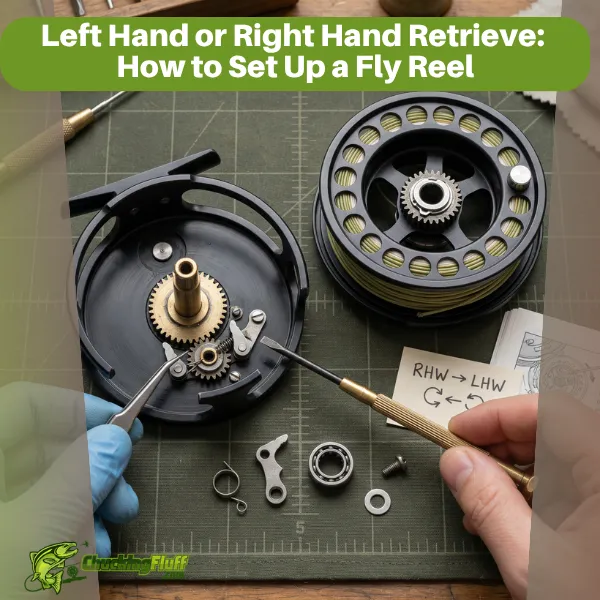
For a left hand or right hand retrieve fly reel, set it up so you reel with your non-casting hand. Keep the rod in your casting hand the whole time, and you never swap hands after a fish takes. Most beginners are better off with that setup, and many reels can be changed to suit.
What do left hand and right hand retrieve actually mean?
Retrieve names the hand that turns the reel handle. With a left hand retrieve (LHR) you crank with your left hand, and with a right hand retrieve (RHR) you crank with your right.
The names describe the reel, not you. A right-handed caster who keeps the rod in the right hand and reels with the left is using a left hand retrieve reel.
|
Your casting hand |
Hand that reels |
Reel you need |
|---|---|---|
|
Right |
Left |
Left hand retrieve |
|
Left |
Right |
Right hand retrieve |
If a listing only says “LHR” or “RHR”, this table tells you which one fits your plan.
Which hand should a beginner reel with?
A beginner should reel with the non-casting hand, so the rod never leaves the hand that casts it. The reel is set up to match, and the whole fight happens without a handoff.
Swapping hands mid-fight is where new anglers get into trouble. You are managing a bent rod, loose line and a moving fish, and moving the rod from one hand to the other adds a moment when tension can slip. A dropped rod tip or a bit of slack gives the fish a chance to shake the hook.
There is a second reason. Your non-casting hand is already the line hand. It strips line, holds it against the rod and feeds it out on the next cast. Reeling with that same hand means one hand handles all the line and the other handles the rod.
Keeping this habit from your first day also means you build one routine instead of learning a second one later.
How much reeling do you really do in fly fishing?
Less than most beginners expect. In a lot of trout fishing you bring in line by stripping it with your hand, and the reel mostly stores line between casts.
The reel does its work in a few moments:
- Taking up slack after a cast or a hookset
- Getting a fish that makes a run onto the reel so the drag can work
- Bringing a larger fish in once it has tired
- Storing line when you move between spots
This is why the choice matters less for comfort than for consistency. You are not cranking all day, so a slightly weaker non-casting hand is not a problem. What matters is that the few times you do reel, the rod stays steady in your casting hand. For how drag, backing and line weight affect those moments, the Fly Reels Explained article covers them, so I will not repeat it here.
When does switching hands make sense?
Switching makes sense when reeling with your dominant hand clearly works better for you, and plenty of experienced anglers do it. It is a legitimate choice. It just is not the best default for a first reel.
These are the cases where it can be reasonable:
- You already reel comfortably with your casting hand. If you have fished this way before and it feels natural, there is no reason to retrain.
- You have limited strength or dexterity in your non-casting hand. Cranking with your stronger hand can be easier.
- You buy a used reel set up the opposite way. If it is not convertible, you may decide to adapt to it rather than pay for a different reel.
- You expect long, hard runs. Some anglers prefer their dominant hand on the handle for big fish, though that is not a typical beginner situation.
If you do switch, practise the handoff at home before you are on the water with a fish on. Rod in one hand, reel handle in the other, then swap. It should feel automatic, not like a decision.
Is your reel convertible, and how do you change the retrieve?
Many fly reels are convertible, meaning you can change the retrieve direction yourself, but not all are. Check before you buy rather than after.
Here is how to check a reel before buying:
- Read the product description for phrases such as “convertible”, “interchangeable retrieve” or “left or right hand retrieve”.
- Look for a manual or specification sheet on the maker’s site and search it for retrieve or spool instructions.
- If the listing is unclear, ask the seller or the maker directly.
- If you are buying used, ask which way the reel is currently set and whether it was ever changed.
Reels differ in how the change works, so follow the manual for your model. In general the process looks like this:
- Remove the spool from the frame.
- Reverse the clicker or drag mechanism as the manual describes. This often involves repositioning small parts.
- Put the spool back on and check that it turns freely and clicks the right way.
- Spool your line so it leaves the reel in the direction that suits your retrieve.
Do this at home on a table, not on the bank. Small parts are easy to lose, and it is easier to reread instructions when you are not standing in a river.
What are the most common questions about fly reel retrieve?
Is left hand retrieve better than right hand retrieve?
Neither is better in itself. The better one is the one that lets you keep the rod in your casting hand, which for a right-handed caster is left hand retrieve.
Can I change the retrieve on any fly reel?
No. Many reels are convertible, but some are fixed, and the only reliable way to know is to read the description or manual for that model.
Does retrieve direction affect how well the reel works?
Not in any way a beginner needs to worry about. It changes which hand cranks the handle and which way the mechanism is set up, so the reel should still perform as described once it is configured correctly.
What if I am left-handed?
The same rule applies. If you cast with your left hand, keep the rod there and reel with your right, which means a right hand retrieve reel.
Do I need to decide before I buy?
Yes, at least roughly. Know which retrieve you want and check whether the reel is convertible, so you either buy the right setup or can change it yourself.
So which way should you set up your reel?
Set it up so the rod stays in your casting hand and your other hand turns the handle. For a right-handed caster that is a left hand retrieve, and for a left-handed caster it is a right hand retrieve.
Choose differently only if you have a clear reason, such as strong existing habits or a reel you cannot convert. Whatever you pick, check that the reel is convertible before you buy, and set it up at home before the first trip.
Pick your first reel next: read How to Choose Your First Dry Fly Rod and Reel Setup.
Fly Fishing Reels Explained – More than a Fly Line Container?

Exploring Different Fly Box Brands – Top Sellers

How to Trout Fish with a Fly Rod – Part two, the rod.
About Author
