
| Disclosure: Just to be open and honest the buttons and links you click on in the website will in most cases take you to another website where you can purchase the products I am reviewing. As an Amazon Associate I earn from qualifying purchases. |
Streamer Retrieve Speeds for Trout: Strip, Pause and Twitch Explained
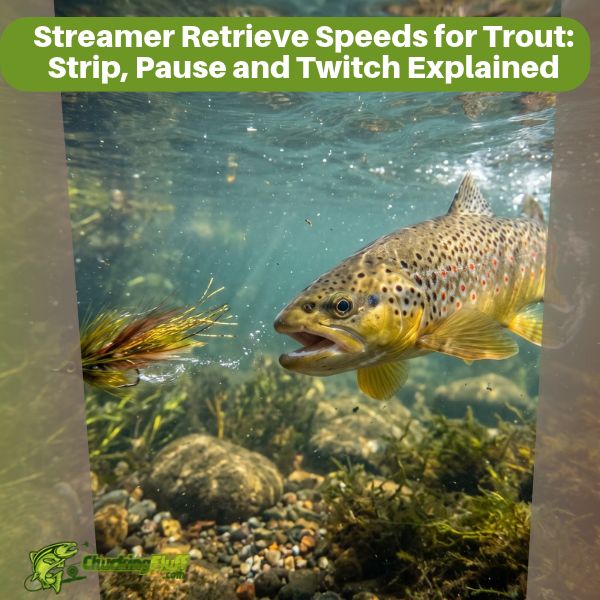
A streamer retrieve for trout is built from three moves: a strip that pulls the fly forward, a pause that lets it hang or sink, and an occasional twitch that makes it dart. Start with a steady medium strip followed by a one-second pause, then slow down or speed up depending on how the fish respond.
This guide covers what happens after the cast. If you are still deciding when a streamer is the right fly, start with the beginner’s guide to nymphs, dries and streamers. Here we stick to the retrieve itself.
What does a streamer retrieve actually do to the fly?
The retrieve is the only thing that makes a streamer look alive, because a streamer that is not moved is just a clump of feathers, fur or synthetic fibre in the current. Trout eat streamers because they resemble baitfish, leeches and sculpins, and each of your three moves changes how that imitation behaves.
|
Move |
What the fly does |
What a trout may read it as |
|---|---|---|
|
Strip |
Moves forward in a line, pulled by the leader |
A baitfish swimming or fleeing |
|
Pause |
Stops moving forward, sinks or hangs, soft materials open and settle |
A fish that is tired, injured or distracted |
|
Twitch |
Jerks a short distance, then settles |
A fish that has just darted or been startled |
A beginner does not need a different retrieve for every pattern. You need to know that the strip makes the fly look like it is going somewhere, the pause makes it look catchable, and the twitch adds a sudden change. Almost every named retrieve is some mix of those three.
How do you strip a streamer, and how fast should you go?
You strip a streamer by pulling line in with your non-rod hand while the rod tip stays low and points at the fly. A good starting pace is roughly one strip per second, with each strip pulling in four to eight inches of line.
Here is the basic sequence to use after the fly lands:
- Point the rod tip at the fly with the tip close to the water, so there is no slack between you and the fly.
- Pinch the line against the rod handle with the index finger of your rod hand.
- Pull the line with your other hand in a smooth, short strip.
- Let the line go slack in your stripping hand only as far as needed, then take the next strip.
- Keep going until the fly is a rod length or so from you, then lift it and cast again.
Keeping the rod low matters for two reasons. It removes slack, so you feel a take, and it leaves room to move the rod sideways if a fish hits. If the rod tip is high, you have slack line on the water and a fish can eat the fly without you noticing.
When a trout takes, keep stripping and sweep the rod to the side to set the hook. Lifting the rod straight up as you would for a dry fly often pulls the fly out of the fish’s mouth, so let the strip do the work first and lift after you feel weight.
Why does the pause catch more trout than the strip?
The pause catches trout because a fly that stops looks like an easy meal, while a fly that never stops looks like something that is getting away. Trout often follow a moving streamer for a while and commit to it only when it slows or changes pace.
During the pause, the fly stops moving forward, and the current or its own weight takes over. A weighted fly sinks. An unweighted fly hangs or drifts with the current. Soft materials such as marabou open up and settle, which is the movement that looks injured.
For a first pause length, use these guidelines:
- Start with one second between strips.
- Extend to two or three seconds when the water is cold or the fish are not responding.
- Shorten the pause if your fly is sinking into snags or the bottom.
Keep the line tight during the pause. A lot of takes happen right as the fly stops, and a trout that grabs a hanging fly may not pull hard. If the line twitches, stops, or feels heavy, treat it as a bite and strip-set.
When should you add a twitch to your retrieve?
Add a twitch once the strip and pause feel natural, and use it when trout follow the fly but turn away, or when the water is clear and calm. A twitch is a small, quick movement of the rod tip that jerks the fly a short distance and then lets it settle.
You can make a twitch two ways. You can shake the rod tip a short distance, an inch or two, or you can make one very short, quick strip of an inch or so. Either one works, so use whichever you can do without adding slack.
Place the twitch in the pause, so the sequence becomes strip, strip, pause, twitch, pause. Used sparingly, it gives the fly the sudden change that often triggers a strike.
Good times to try it:
- When you see a trout follow the fly and then drift off.
- In slow, clear water where fish have a long look at the fly.
- When a steady strip and pause has produced nothing after several casts.
Do not twitch constantly. A fly that jerks on every move stops looking injured and starts looking erratic, and the effect disappears.
How do you match your retrieve speed to the water and the fish?
You match retrieve speed by starting with the default (medium strip, one-second pause) and changing one thing at a time depending on water temperature, current and clarity. The fish tell you what to change, and they do it through follows, bumps and nothing at all.
|
Conditions |
Start with |
|---|---|
|
Cold water |
Slower strips, longer pauses |
|
Warm water |
Faster strips, shorter pauses |
|
Fast current |
Fewer, shorter strips, because the current already moves the fly |
|
Slow pool |
More pauses and an occasional twitch |
|
Murky or stained water |
Bigger, more deliberate strips so fish can detect the fly |
|
Clear water |
Smaller movements, longer pauses |
Reading the water also tells you where to place the fly in the first place. The guide on how to read a trout stream is written around nymphs, but the same seams, banks and slower pockets are where trout hold when they are looking for a streamer.
The quick fix list
When the fish ignore your fly, work down this list one change at a time and give each change several casts before moving on:
- Add a pause if you have been stripping without stopping.
- Slow down if fish follow but do not eat.
- Speed up if you get nothing and the water is warm.
- Lengthen the pause in cold water.
- Add a twitch inside the pause.
- Let the fly sink deeper before you start stripping.
- Change the angle, for example by casting across the current instead of straight down, so the fly crosses a different part of the water.
Changing everything at once tells you nothing, because you will not know which change helped. Change one thing, fish it for several casts, then change the next.
What retrieve mistakes make beginners go fishless?
The most common mistake is stripping at one speed for the whole retrieve, with no pause. A fly that moves at one steady pace gives a trout very little reason to commit.
These are the others to watch for:
- Stripping too fast. A fly that races past looks like it is escaping, and trout often will not chase it. If you are unsure, go slower.
- Holding the rod tip high. Slack builds between you and the fly, and you miss takes.
- Lifting the rod to set the hook. This pulls the fly away from a trout that has only just taken it. Strip-set instead.
- Stopping the retrieve too early. Trout often follow the fly right to your feet, so keep stripping until the fly is close, and then pause it before you lift for the next cast.
- Using the same retrieve every cast. If a pattern has not worked after several casts, vary it.
- Changing several things at once. You cannot learn from a result when you do not know what caused it.
- Giving up after a few casts. A streamer covers water, so keep moving along the bank and cover new water while you test your changes.
FAQs
How fast should I strip a streamer for trout?
Start with about one strip per second, pulling in four to eight inches each time, and then adjust. Slow down in cold water or when fish follow without eating, and speed up in warm water when nothing is responding.
How long should I pause between strips?
Use one second as your default. In cold water or when fish are sluggish, stretch the pause to two or three seconds. Keep the line tight during the pause, because many takes happen as the fly stops.
What should I do if trout follow the fly but will not take it?
Slow the retrieve, lengthen the pause and add a small twitch during it. If that does not work, change the angle of the cast so the fly crosses the fish’s view differently, or try a different fly size or color.
How do I know a trout has taken a streamer?
You may feel a tug, see the line stop or twitch, or feel the fly suddenly get heavy. Sometimes you will see a flash in the water. Treat any of these as a strike and set the hook with a strip and a sideways sweep of the rod.
Do I need a different retrieve for weighted and unweighted streamers?
Weighted streamers sink faster, so use shorter pauses when you are fishing near the bottom or snags. Unweighted streamers stay higher in the water, so you can pause longer without losing depth.
What retrieve should you try on your next trout trip?
Use this default and change one thing at a time. Cast across the current, keep the rod tip low, then strip about one strip per second with a one-second pause between strips.
After several casts with no response, work through the quick fix list: lengthen the pause, slow down or speed up depending on the water temperature, and add a twitch inside the pause. When a trout follows or takes, note exactly what you were doing and repeat it.
AFFTA Grain Weights Vs. Head Tapers: The Confusion
How to Choose Your First Dry Fly Rod and Reel Setup

Essential Flies For Every Fly Fishing Angler
About Author
