
| Disclosure: Just to be open and honest the buttons and links you click on in the website will in most cases take you to another website where you can purchase the products I am reviewing. As an Amazon Associate I earn from qualifying purchases. |
Tippet Size for Dry Flies: How to Stop Picking One Too Thick
Most beginners pick their tippet the same way they pick socks out of a drawer: whatever’s on top gets used. You tied on a 4X tippet last trip, there’s still line left on the spool, so 4X goes on again today, regardless of what fly you’re fishing or what the water looks like. That habit will cost you fish, and it’s one of the easiest things in fly fishing to fix once you understand what tippet size actually does.
This article walks through a simple way to pick the right tippet for dry fly fishing, every time, based on the fly you’re tying on and the water you’re fishing, not whatever happens to be convenient.
Why Tippet Thickness Makes or Breaks a Dry Fly Presentation
Tippet is the thin, clear line that connects your leader to your fly. With dry flies, its job is twofold: it has to be invisible enough that a fish rising to the surface doesn’t spook off a thick, obvious line, and it has to let the fly move naturally on the water instead of dragging or skating unnaturally.
Thicker tippet is stronger, but it’s also stiffer and more visible. Tie a heavy tippet to a size 18 dry fly and two things work against you. First, the fly can’t float and drift the way it’s designed to, because the stiff material fights the current instead of letting the fly ride with it. Second, a fish looking up at the surface on a calm pool can see that line, and a fish that sees your line usually isn’t a fish you catch.
Thinner tippet solves both problems, but it comes with a tradeoff: less breaking strength, and less abrasion resistance. Go too thin and you’ll lose fish to break-offs, or snap off on a hookset that’s a little too eager. The goal is to find the thinnest tippet that still gives you enough strength for the fish and water you’re fishing, which is really a balance between stealth and strength, not a single magic number.
The X System Explained: What 4X, 5X, and 6X Actually Mean
Tippet is labeled with an “X” rating, and if you’re new to it, the numbers can seem backwards at first. Here’s the rule: the higher the X number, the thinner the tippet and the lower the breaking strength. A 6X tippet is thinner and weaker than a 4X tippet, even though 6 is the bigger number.
The X rating actually comes from an old system that measured how far a tippet’s diameter was from a reference thickness, but you don’t need the history to use it. You just need to know the rough diameter-to-strength relationship, which looks something like this:
- 3X: roughly .008 inch diameter, breaking strength around 8 to 9 pounds
- 4X: roughly .007 inch diameter, breaking strength around 6 pounds
- 5X: roughly .006 inch diameter, breaking strength around 4 to 5 pounds
- 6X: roughly .005 inch diameter, breaking strength around 3 to 4 pounds
- 7X: roughly .004 inch diameter, breaking strength around 2 pounds
Exact numbers vary a bit by brand, so treat these as a general guide rather than a spec sheet. What matters is the pattern: each step up in X number means a noticeably thinner, lighter tippet. For dry fly fishing on most trout water, you’ll spend the majority of your time somewhere between 4X and 6X, with 5X being the size a lot of anglers reach for first when they’re not sure what else to use.
Matching Tippet Size to Fly Size, Not the Other Way Around
Here’s the fix for the spool habit: pick your fly first, then let the fly size tell you what tippet to use. A tiny fly tied to thick tippet looks wrong in the water and won’t drift right, no matter how good your cast is. A big, bushy fly tied to thin tippet can work, but you’re leaving strength on the table that you don’t need to.
A simple rule that guides a lot of experienced dry fly anglers divides the fly’s hook size by three to get a rough tippet X size. So a size 18 fly points you toward 6X, a size 12 fly points you toward 4X. It’s not an exact formula, but it’s a useful starting place, and here’s a more practical breakdown by fly size:
- Size 10 to 12 flies (larger attractor patterns, big hoppers, stoneflies): 3X to 4X
- Size 14 to 16 flies (standard mayfly and caddis patterns): 4X to 5X
- Size 18 to 20 flies (smaller mayflies, midge patterns, finicky hatch-matching): 5X to 6X
- Size 22 and smaller (tiny midges, spinner falls): 6X to 7X
If you’re not sure which type of fly you’re tying on in the first place, our beginner’s guide to choosing a fly covers the basics of nymphs, dries, and streamers and will help you get comfortable picking the right pattern before you even think about tippet.
The logic here isn’t arbitrary. A heavier tippet on a small fly overpowers the fly’s natural movement and makes it sit unnaturally stiff in the water. Thinner tippet on a small fly lets it drift the way the naturals around it are drifting, which is most of what convinces a trout to eat.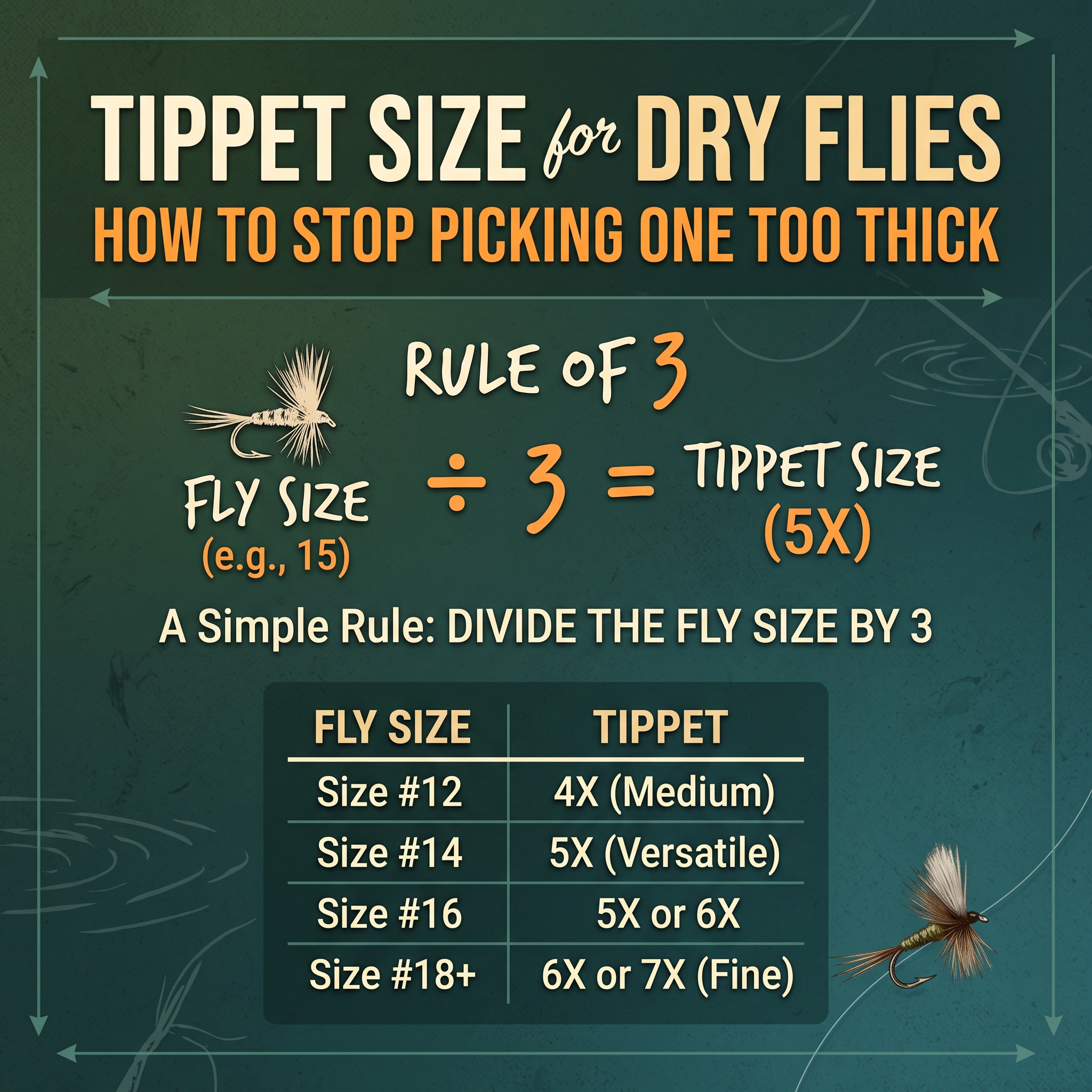
Reading the Water: When to Size Down for Clear or Pressured Fish
Fly size is the starting point, but water conditions push you up or down from there. Two things matter most: how clear the water is, and how much fishing pressure the fish have seen.
Clear, calm water gives fish a much better look at your line. On a slow-moving spring creek or a gin-clear pool where you can see every pebble on the bottom, a trout gets a long, careful look at anything drifting over it, tippet included. In that kind of water, it often pays to size down one notch from what the fly size alone would suggest. If you’d normally reach for 5X on a size 16 fly, try 6X instead.
Pressured fish, meaning fish that get cast to often on popular water, tend to get more line-shy over time. They’ve seen leaders before and they’ve learned to associate a certain shape or flash with danger. On heavily fished water, sizing down helps, even if the water itself isn’t perfectly clear.
Faster, broken, or off-color water works the other way. Current breaks up the surface and makes your tippet harder for a fish to inspect closely, and a fish in faster water generally has less time to study what’s drifting toward it before deciding to eat or refuse. In that water, you can often stay at the thicker end of the range the fly size suggests, or even size up slightly if you’re worried about break-offs around structure.
A rough way to think about it: start with the fly-size tippet recommendation, then ask yourself how good a look the fish is going to get. Long, careful look in clear water means go thinner. Quick decision in fast water means you can stay thicker.
The One Mistake Almost Every Beginner Makes (And How to Catch It)
The single most common mistake is using one spool of tippet for an entire day, or an entire season, regardless of fly size. It happens for an understandable reason: buying and carrying multiple tippet sizes feels like one more thing to manage, so a lot of beginners just buy a single spool, usually 4X or 5X, and use it for everything.
The problem shows up in a specific, recognizable way on the water: you get refusals. Fish rise toward your fly, look at it, and turn away at the last second without taking it. That’s often not a fly pattern problem at all. It’s frequently a tippet problem, specifically tippet that’s too thick for the fly size or the water clarity, and the fish is reacting to the leader rather than rejecting the fly itself.
Here’s how to catch it happening: if you’re getting consistent refusals on a fly you’re confident matches the hatch, size down your tippet by one X before you change flies. Try a 6X in place of a 5X, or a 5X in place of a 4X. If the refusals stop and you start getting solid takes, you’ve just confirmed it was a tippet issue, not a fly issue, and you’ve learned something you can apply for the rest of the season.
The fix going forward is simple: carry more than one spool. You don’t need ten sizes, but having three or four lets you match the fly instead of making the fly match whatever’s already tied on your leader.
Fluorocarbon vs Nylon for Dry Fly Tippet
Once you’ve settled on a size, there’s a material choice to make too: fluorocarbon or nylon (often labeled “monofilament” on the spool).
Nylon has been the standard dry fly tippet material for a long time, for good reason. It floats more naturally on the surface, which matters for dry fly fishing since you want your tippet sitting on top of the water with the fly, not sinking just below it and pulling the fly down with it. Nylon is also more supple, which helps a small dry fly drift naturally instead of getting held back by stiff line. It’s generally cheaper too, which matters if you’re going through tippet regularly.
Fluorocarbon sinks, which is exactly what you want for nymphs and streamers fished below the surface, but it’s a mixed bag for dry flies. Fluorocarbon is denser and less visible underwater, and it resists abrasion better, which can help in rocky or snaggy water. But that same density that makes it good for sinking flies can work against you on top of the water, where you generally want your tippet floating rather than sinking.
For most dry fly fishing, nylon is the more practical choice, and it’s what most anglers default to. If you’re planning to fish both dries and nymphs on the same outing, it’s worth carrying both: nylon for your dry fly tippet, fluorocarbon for anything you’re fishing subsurface. If you want to get more into nymphing specifically, our guide to nymphing techniques covers how tippet and leader setup changes once your fly is underwater instead of on top.
Building a Simple Tippet Kit for Your Vest
You don’t need every size on the shelf to be well equipped. A practical dry fly tippet kit covers the range you’ll actually use without weighing down your vest or overcomplicating your setup.
A solid starting kit looks something like this:
- 4X spool: for larger dries, size 10 to 14, and for faster or off-color water
- 5X spool: your all-purpose size for standard mayfly and caddis patterns, size 14 to 18
- 6X spool: for smaller flies, size 18 to 22, and for clear, calm, or pressured water
- 7X spool (optional): for tiny midges and the most finicky spring creek or pressured fish situations
Four spools cover the overwhelming majority of dry fly situations you’ll run into as you build experience. Keep them somewhere easy to reach, a vest pocket or a small tippet holder that clips to your pack, so swapping sizes takes seconds rather than becoming a reason not to bother.
It’s worth checking your spools periodically too, not just for length remaining but for condition. Tippet that’s been sitting in a hot car or in direct sun for a season can weaken even if there’s plenty left on the spool, and old, brittle tippet is a common, invisible cause of lost fish that gets blamed on the knot or the hookset instead.
If you’re still working out the rest of your setup and want to make sure your rod, reel, and leader all pair well together without overspending, our fly combo buying guide for budget-conscious anglers walks through how to put together a solid rig without paying for features you don’t need yet.

What Accessories are needed to Fly Fish? A Beginners Guide
How to Choose a Fly Fishing Reel -Tips for the Beginner

Must-Have Accessories For Beginner Fly Fishers
About Author
