
| Disclosure: Just to be open and honest the buttons and links you click on in the website will in most cases take you to another website where you can purchase the products I am reviewing. As an Amazon Associate I earn from qualifying purchases. |
Dry fly vs nymph fishing: which should beginners learn first
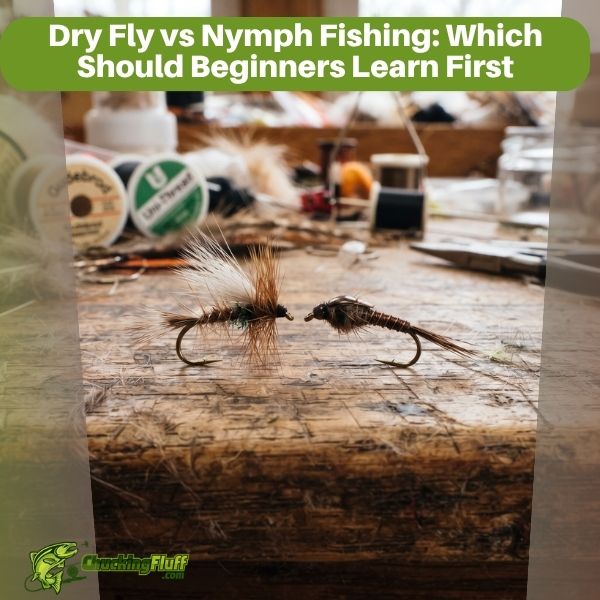
Ask ten experienced fly anglers whether a beginner should start with dry flies or nymphs, and you’ll get ten different answers, most of them delivered with total confidence. That’s because the question sounds simple but isn’t. It’s really two separate questions tangled together: which technique will make you a better angler faster, and which one will actually put fish on the end of your line while you’re still figuring out which way is upstream.
Those two answers aren’t the same, and that’s exactly what trips people up. The technique that looks best in photos and videos isn’t the one that builds skill fastest, and the one that catches the most fish early on isn’t the one most beginners reach for first. If you’ve already read about the difference between types of fly fishing flies for beginners and you’re just trying to decide where to spend your first season, this is the comparison that actually matters.
Why this question trips up almost every new angler
Most new anglers pick a starting technique based on what they’ve seen, not what will teach them the most. Dry fly fishing gets all the attention: a trout rising to sip a fly off the surface is the image that sells fly fishing in every film and every magazine cover. Nymph fishing, by comparison, looks like watching a bobber. It’s less romantic, so it gets skipped.
The problem is that romance and skill-building aren’t the same thing. A technique can be visually unremarkable and still be the better classroom. The anglers who struggle most in their first season are usually the ones who picked their approach based on what they wanted to be true, not what the water and the fish were telling them. Settling this question honestly means separating what’s fun to imagine from what actually works when you’re standing in a river for the first time.
What dry fly fishing actually demands of you on the water
Dry fly fishing asks a lot of a beginner before it gives anything back. You need to spot a rising fish, which means reading subtle disturbances on the surface that are easy to miss or misread. You need to figure out what the fish is eating, which means paying attention to insects you may never have noticed before. Then you need to present a fly that drifts naturally, without drag, which requires a cast and a line mend that most people don’t develop in a single afternoon.
None of that is impossible, but it stacks up. A beginner fishing dry flies is often trying to solve three or four problems at once: observation, fly selection, casting accuracy, and drift control. Miss any one of them and the fish simply ignores the fly, often without you knowing why. That silence is the hardest part. Nymph fishing gives you feedback. Dry fly fishing, early on, often gives you nothing at all, and nothing is a frustrating teacher.
What nymph fishing actually demands of you on the water
Nymph fishing asks something different of you. Instead of reading the surface, you’re reading the water column: depth, current speed, and where fish are likely holding below a surface that often shows no sign of them at all. You need enough weight to get your fly down to where the fish are feeding, and you need to detect a strike that might be nothing more than a tiny pause or twitch in your indicator or line.
That’s a real skill, and it’s arguably a more useful one for a beginner to build first. Learning to judge depth and drift without being able to see the fish teaches you to understand what’s happening underwater, which is where most trout spend most of their time regardless of what technique you’re using. It also builds patience with a different kind of feedback: more frequent strikes, even if some are subtle ones you’ll miss at first. If you want a deeper walkthrough of how this actually works on the water, the Hub’s guide to nymphing technique breaks down drift, depth, and strike detection step by step.
Why nymphs catch more fish while you’re still learning to read water
Trout feed below the surface far more often than they feed on top. Most studies and most experienced guides will tell you the same thing: somewhere around 80 to 90 percent of a trout’s diet comes from underwater, not from insects floating by. That means nymph fishing is putting your fly where the fish actually are, most of the time, regardless of your skill level.
This matters enormously for a beginner because it changes the math on your early days. With nymphs, you can make a mediocre presentation and still get a strike, because you’re fishing the part of the water column where fish are concentrated and feeding reliably. With dry flies, a mediocre presentation usually means no interest at all, because you’re asking fish to break their normal feeding pattern and come up for something that has to look perfect.
Catching fish while you’re learning isn’t just about ego. It’s about feedback. Every strike, even a missed one, teaches you something about depth, drift, and timing. A beginner who starts with nymphs will likely get more of those teaching moments per hour on the water than one who starts with dries, simply because there are more opportunities for things to go right.
The case for starting with dry flies anyway
None of that means dry flies are a bad place to start. There’s a real argument for beginning there, and it has nothing to do with catching more fish. Dry fly fishing forces you to slow down and observe in a way that nymphing doesn’t demand as urgently. You have to watch the water, notice rises, identify insects, and think about presentation before you ever make a cast. That discipline carries over into every other kind of fly fishing you’ll do later.
There’s also something to be said for starting with a technique that gives you a clear, visible result. When a fish rises and takes your dry fly, you see the whole event: the take, the set, the fight. That clarity can make the learning curve feel more connected and less abstract than watching an indicator and guessing what’s happening twelve inches under the surface. For some beginners, that visible cause and effect builds confidence faster than more frequent but harder-to-read strikes ever could.
The honest position is that dry fly fishing teaches observation and precision, while nymph fishing teaches volume and feedback. Neither case cancels the other out, which is exactly why the decision is harder than it looks.
What each approach teaches you that the other can’t
It helps to separate what you’re actually trying to learn in your first season, because dries and nymphs aren’t interchangeable classrooms. They teach different things, and a beginner benefits from knowing which lesson they’re signing up for.
Dry fly fishing teaches you to:
- Read the surface and spot subtle rises
- Identify insects and match a hatch
- Control drag and manage a drift with precision
- Make a delicate, accurate cast
Nymph fishing teaches you to:
- Read current speed and depth without visual cues
- Judge how much weight you need to reach feeding fish
- Detect strikes that are often faint or ambiguous
- Understand where fish actually hold in a river, not just where they feed on top
Notice that these skill sets barely overlap. That’s the real argument for not picking one and ignoring the other entirely. A beginner who only ever fishes dries will struggle badly the first time they try to nymph, and vice versa. The two techniques are complementary tools, not competing philosophies, even though most gear shops and guide services present them that way.
How to practice both without wasting your first season
You don’t need to split your first season exactly in half to get the benefit of both techniques. A more realistic approach is to let conditions decide, and to use nymphs as your default while treating dry fly fishing as something you deliberately practice when conditions invite it.
Early in the day, or on overcast days with no visible insect activity, nymph. You’ll get more strikes, more practice reading water, and more chances to build confidence. When you see fish rising, or when there’s an obvious hatch coming off the water, switch to a dry fly and treat that window as a dedicated practice session, even if you only land one or two fish. Those are the moments the skill is meant for, and forcing yourself to try during a hatch, rather than randomly, gives you the best odds of connecting your effort to a result.
Keep a simple mental note, or even a written one, of what worked and what didn’t each time you’re on the water. Which depth got strikes. Which fly pattern matched what fish were rising to. That kind of tracking turns a season of fishing into a season of practice, rather than a season of repeating the same guesses.
Tackle recommendations for either technique
The good news is that you don’t need two completely different setups to practice both techniques in your first season. A standard 9-foot, 5-weight rod and matching reel will handle both dry flies and nymphs reasonably well, which makes it a sensible starting point if you haven’t bought gear yet. If you’re still deciding on a setup, our guide to the best beginner fly fishing rod and reel combo walks through what actually matters when you’re choosing one.
What changes between the two techniques is mostly in the smaller details: leader and tippet, and the terminal gear you attach. Nymphing typically calls for a longer leader with some added weight, either split shot or a weighted fly, plus a strike indicator to help you see subtle takes. Dry fly fishing calls for a finer, more delicate tippet so your fly lands softly and drifts naturally. Getting that tippet size wrong is one of the most common reasons beginners struggle with presentation, and it’s worth getting right before you blame your casting. This guide on what tippet size for dry fly fishing actually means is a useful reference the first time you’re standing in a shop aisle trying to decide between a 4X and a 6X spool.
Beyond that, a basic selection of both nymph and dry patterns in common sizes will cover most beginner water. You don’t need dozens of patterns. You need a handful that match common insects in your area and the confidence to fish them properly, which comes from practice rather than from having more flies in your box.
Our honest answer: what we’d tell a friend starting out
If a friend asked us where to focus a first season, the honest answer is to lead with nymphs and treat dry fly fishing as a skill you build alongside it, not after it. Nymphing will put more fish on your line while you’re still learning the basics of reading water, casting, and detecting a strike, and that early success matters more than most beginners realize. Confidence built from actual catches tends to stick, while confidence built from theory alone tends to evaporate the first time a session goes badly.
That said, don’t avoid dry fly fishing just because it’s harder. Use it deliberately, especially when conditions make it the obvious choice, like a visible hatch or rising fish. Treat those moments as practice rather than as a test you’re failing if you don’t land something. The skills you build chasing dry fly takes, observation, delicate presentation, drift control, will make you a sharper nymph angler too, because reading a river well is really one skill with two different applications.
The honest answer isn’t the one that photographs well. It’s the one that gets you more time connected to fish during the part of your fly fishing life when every connection teaches you something.
Conclusion
There’s no universal rule that says every beginner has to start with nymphs, and there’s no rule that dry fly fishing is only for anglers who’ve already paid their dues. What matters is understanding what each technique actually demands and what it actually teaches, so you can make a decision based on your first season’s goals rather than on what looks good in a highlight reel. Nymphing will likely get you more fish and more usable feedback while you’re building fundamentals. Dry fly fishing will sharpen your observation and precision in ways nothing else quite does. Used together, deliberately, they’ll get you further than either one alone.
FAQs
Is nymph fishing easier than dry fly fishing for beginners? In terms of catching fish, yes. Nymphing targets where trout spend most of their time feeding, so even an imperfect presentation can produce a strike. Dry fly fishing demands more precision before you see any result, which makes it feel harder even though neither technique is inherently simple.
Should I learn to cast before trying nymphs or dries? A basic, functional cast is useful for either technique, but you don’t need to master casting before starting. Nymph fishing is actually a reasonable way to build casting feel, since the stakes of a slightly rough cast are lower than they are with a delicate dry fly presentation.
Can I fish nymphs and dries with the same rod? Yes. A standard 5-weight setup handles both reasonably well for a beginner. What usually needs to change is your leader, tippet, and whether you’re adding weight or an indicator, not the rod itself.
How do I know when to switch from nymphs to dry flies? Watch the water. Rising fish or visible insect activity on the surface are the clearest signals that a dry fly presentation is worth trying. Absent those signs, nymphing below the surface is usually the more productive choice.
Do I need different flies for each technique, or can I carry a small selection of both? A small, well-chosen selection of both nymph and dry patterns in common sizes for your local water is enough to start. You don’t need a large fly box in your first season, just patterns that match what’s actually active where you’re fishing, and the willingness to fish them with attention.
“Check out some of our Buying Guides”
Why Leaders And Tippets Are The Unsung Heroes Of Fly Fishing
Fly Combo Buying Guide For Budget-Conscious Anglers
Can Fly Reels Be Too Light – Navigating the Weight Debate:
About Author
